

Tips and Tricks
-
Creating Website Content for Better User Experiences
Modeling and designing your website’s user experience means attempting to understand all aspects of the user’s online and offline interaction with your company, and how the site is perceived, learned, and used in order to make informed decisions that will improve your users’ experiences. Designing a great user experience or “UX” sounds like a tall order, but this post will provide you with some of the resources you’ll need to create content that will meet visitors’ expectations. Web writing, Web design, and blogging consultant Lorelle VanFossen said in a recent presentation, “Every user experience journey begins with the words ‘I want…’,…
-
Does your website have an effective call to action?
A “call to action”, as the name suggests, tells your visitors what they should do. In the case of a website, it’s basically a message that links to a desired action. A successful CTA will help persuade visitors to take your desired action, which you should be able to determine based on your business goals. It can be a short phrase as simple as “Click here!”, but should be something at least a little more specific or sophisticated. In this Online Friendly article, we break down some of the core concepts of designing an effective CTA. Think of your audience…
-
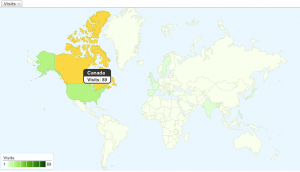
How to read your site’s statistics: 6 tips
As we wrote in a previous post, statistics are necessary to determine if your website is meeting its goals. But it’s hard to know if you’re meeting your site’s goals if you don’t know how to read the multitude of numbers and graphs provided by a service like Google Analytics. In this post, we offer five suggestions on how to read your Analytics statistics beyond simply hits or views to help you determine if your site is attracting the traffic you want and if visitors are getting the experience they want from your site. 1. Determine what your bounce rates…
-
Do you own your blog?: Owning your domain
With the wide variety of free blogging platforms, blogging is essentially free. However, to get the impact you’re looking for, it may be worth it to blog using your own domain. In fact, it can be easy to setup and doesn’t have to be terribly expensive to get your blog on a URL that you own. Many blogging platforms allow you to buy a custom domain, including Google’s Blogger platform, and WordPress.com. You can also transfer a domain name you have already bought for your Blogger or WordPress.com blog. This post will outline some major reasons to take ownership of…
-
Integrating your blog and your website
Having a ‘blog’, featuring news, articles and thought-provoking content, is a great way to help your business gain credibility and enhance its reputation. But in order to make the most impact on both your target market and on search engines, your blog and organization’s website should be well-integrated. There are, however, several different methods of integrating a blog with an existing site, including the use of “iFrames”, rebuilding the site using a blog or CMS platform, creating a new theme or child theme, and using a RSS feeds. Each have their own benefits and drawbacks. iFrames An iFrame is an…
-
Hiding your prices – Don’t do it!
Talking about money is hard, even for online business. Many times when you visit a website, it is not easy to find the prices for the offered services. You can go through three or more different windows with trials and special offers but you cannot find how much you will finally have to pay for them. Some weeks ago, Brent went to the WordPress.com website looking for the prices of the premium features offered by the blog platform. He spent almost 20 minutes browsing the website and he could not find any prices – they simply weren’t available. WordPress.com spoke…
-
Don’t wait, start the sharing
In July, we started a blog series on the importance that an updated website has for your business. In our first blog post about website updates, we discussed how regular updates are a great way to legitimize a small business website. We also explained ways to find website content for your visitors and how to do website updates. In our previous blog post, we talked about the power of social networks and how you can help your visitors share the content of your website with their friends. In our last blog post of this series, we talk about how you…
-
7 Questions to Discover Content For Your Website
In our previous post, we introduced you to the concept of regular ‘website updates’. As we explained, when you frequently change your home page, you tell your visitors that you are an active company. In addition, you show them the value that you give to the communications you have with your clients and potential clients. Your Update Checklist When companies ask our president Brent Kobayashi about ways to create content for their sites, he usually draws a quick checklist. As he explains, this list helps our clients to understand the multiple options they have to easily find new and useful…
-
1 (Big) Step to Legitimize Your Small Business on the Web
When was the last time anything on your home page changed? As you probably already know, your home page is the most important page of your site. Your homepage is the first impression that your clients get of you and your business. Changing it frequently tells your visitors that you are an active company. It will tell them the value that you give to your site and how you see your business. Keep in mind that your website may be the most frequently viewed image of your business. In this first article, we introduce you to the concept of web…
-
6 Basic Search Engine Friendly Tips
In our previous blog post about creating a successful brochure web site, we slipped in a few descriptive links to ourselves and our clients. We did this to help tell Google, Bing, Yahoo and other search engines what these sites are about. Doing this is part of an online marketing strategy called Search Engine Optimization and it is something all business websites should consider. . Search Engine Optimization is a big field, and running a search marketing campaign can take some time (and dollars). However, there some things you can do (and should do!) to make sure your homepage and…